Feature
Skincare Routine Check: Score Your Routine Out of 100 in Two Minutes
DermDecode's skincare routine check asks 19 quick questions about how you look after your skin and how you live, then gives you a score out of 100 and a step-by-step plan. The score comes from fixed rules, not from AI, so the same answers always get the same number. Adults can choose to have the plan written for them by AI. Anyone under 18, and anyone who would rather not send their answers, gets the same score and a general plan worked out on their phone. It takes about two minutes, and you'll find it on the Home screen.
What the skincare routine check asks
The questions come one per screen, with a progress count at the top. They're grouped into four sections:
- About you: your age range, how you describe yourself, your skin type and any current concerns. Age comes first, so the app knows straight away whether you're under 18.
- Your routine: how you wash your face, whether you moisturize, how often you wear SPF 30+, whether you reapply it, which actives you use (retinoid, vitamin C, AHA/BHA, niacinamide) and whether you take makeup off before bed.
- Lifestyle: sleep, water, smoking or vaping, alcohol, sugary or processed food, stress and exercise.
- Environment: how long you spend in the sun each day and whether you use tanning beds.
Two small touches keep it quick. If you never wear sunscreen, the reapplying question is skipped. And if you've already set up your Skin Profile and agreed to the routine check, your skin type and concerns are filled in for you, marked "From your skin profile", so you can confirm and move on.
How the routine score adds up to 100
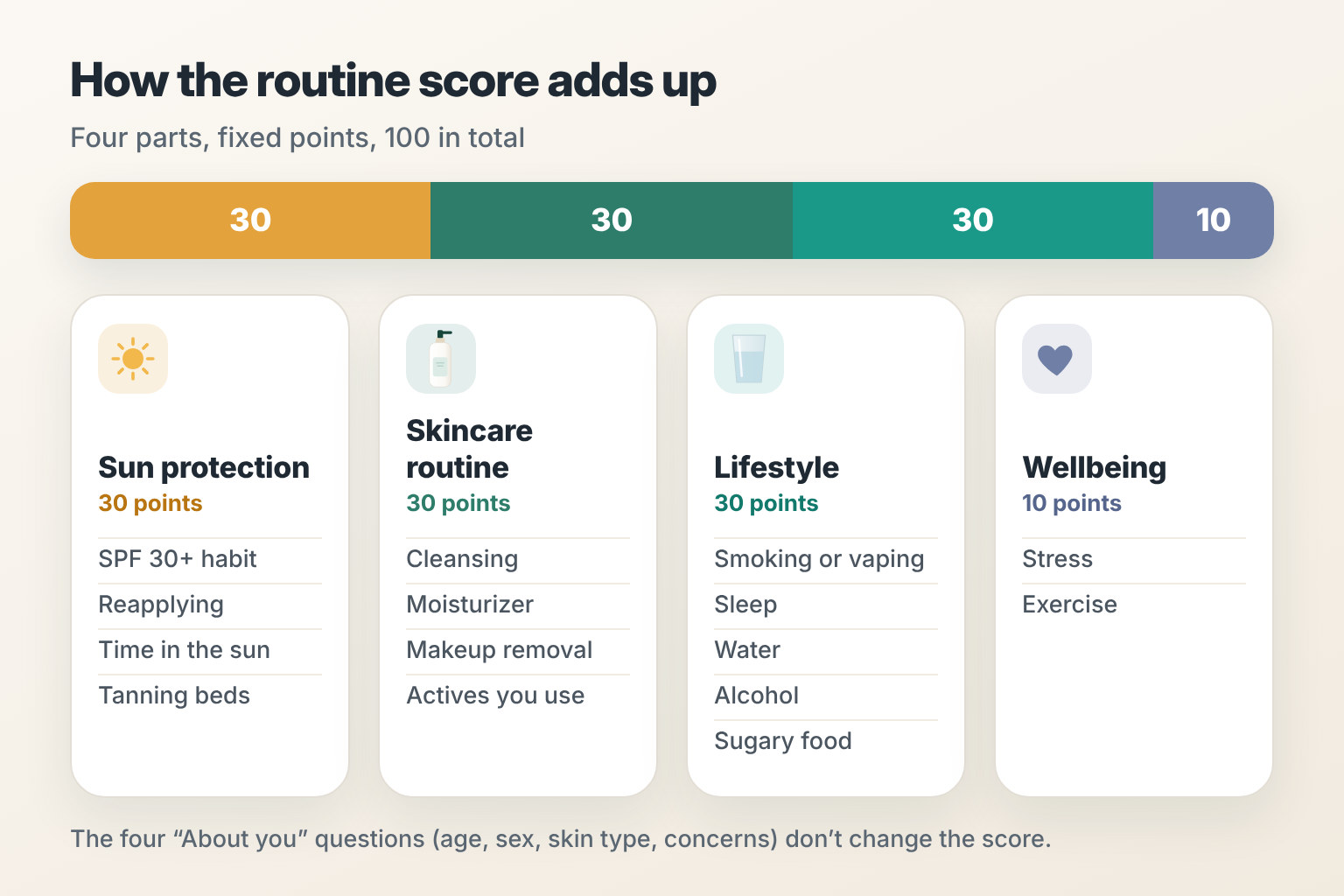
Each answer is worth a set number of points, and the four parts are added up. There's no curve and no comparison with other people. Here is where the biggest points sit:
| Part | Points | Answers worth the most |
|---|---|---|
| Sun protection | 30 | SPF 30+ every day (18), reapplying during the day (4), under 30 minutes in the sun (5), never using tanning beds (3) |
| Skincare routine | 30 | Cleanser twice a day (8), moisturizer twice a day (8), always removing makeup or not wearing any (4), actives (up to 10) |
| Lifestyle | 30 | Never smoking (10), 7–8 hours' sleep (6), over 8 glasses of water (5), rarely eating sugary food (5), not drinking (4) |
| Wellbeing | 10 | Low stress (5), exercising daily (5) |
Every other answer earns fewer points, down to zero.
A couple of details are worth knowing. Washing your face three or more times a day scores lower than twice, and it's flagged as harsh cleansing, because more isn't always better. Actives top out at 10 points: a retinoid is worth 4, and vitamin C, an AHA/BHA exfoliant and niacinamide are worth 2 each. With Pregnancy Mode on, a retinoid earns nothing, for the reasons in our Pregnancy Mode guide.
A worked example: from 64 to 79
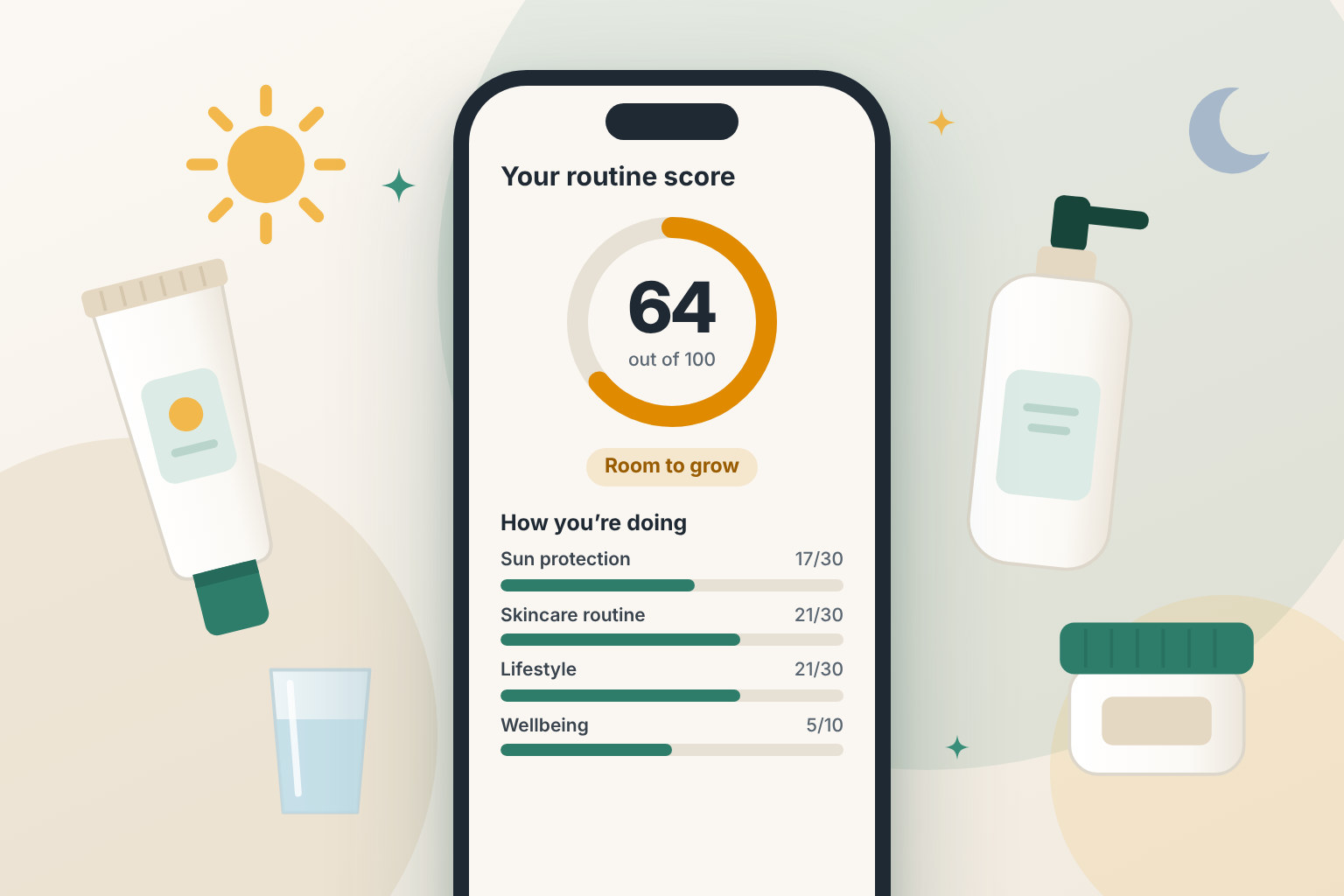
Say you use a cleanser twice a day, moisturize once, wear SPF only on sunny days and don't reapply, use vitamin C and niacinamide, usually take your makeup off, sleep 5–6 hours, drink 3–5 glasses of water, never smoke, drink and eat sugary food now and then, feel moderately stressed and exercise once or twice a week. That comes to 17 + 21 + 21 + 5 = 64, in the "Room to grow" band, with short sleep flagged as a risk.
Now change two habits: SPF every day with a top-up during the day, and 7–8 hours' sleep. Sun protection climbs to 29 and lifestyle to 24, for a score of 79 and a "Good" band. That's how the plan is meant to work: a couple of changes, ranked by how much they matter, rather than a total overhaul.
Reading your results
The results screen opens with your score in a ring and a band underneath:
| Score | Band |
|---|---|
| 85–100 | Excellent |
| 70–84 | Good |
| 50–69 | Room to grow |
| 30–49 | Needs attention |
| 0–29 | Let's turn this around |
Below that you'll find three sections:
- How you're doing: a short note on each of the four parts.
- What matters most: your top risks, such as low sun protection or short sleep, each marked High, Medium or Low.
- Your plan: ranked steps, each with why it helps and two tags, one for effort (Easy, Some effort or Takes commitment) and one for cost (Free, Low cost or Moderate cost). Plenty of them are free.
Plans name product types and habits, like "a broad-spectrum SPF 30+ every morning", never brands. They don't diagnose anything or promise results. Every past check is saved under Settings, in Routine check, so you can compare over time.
Where your answers go, and when they don't
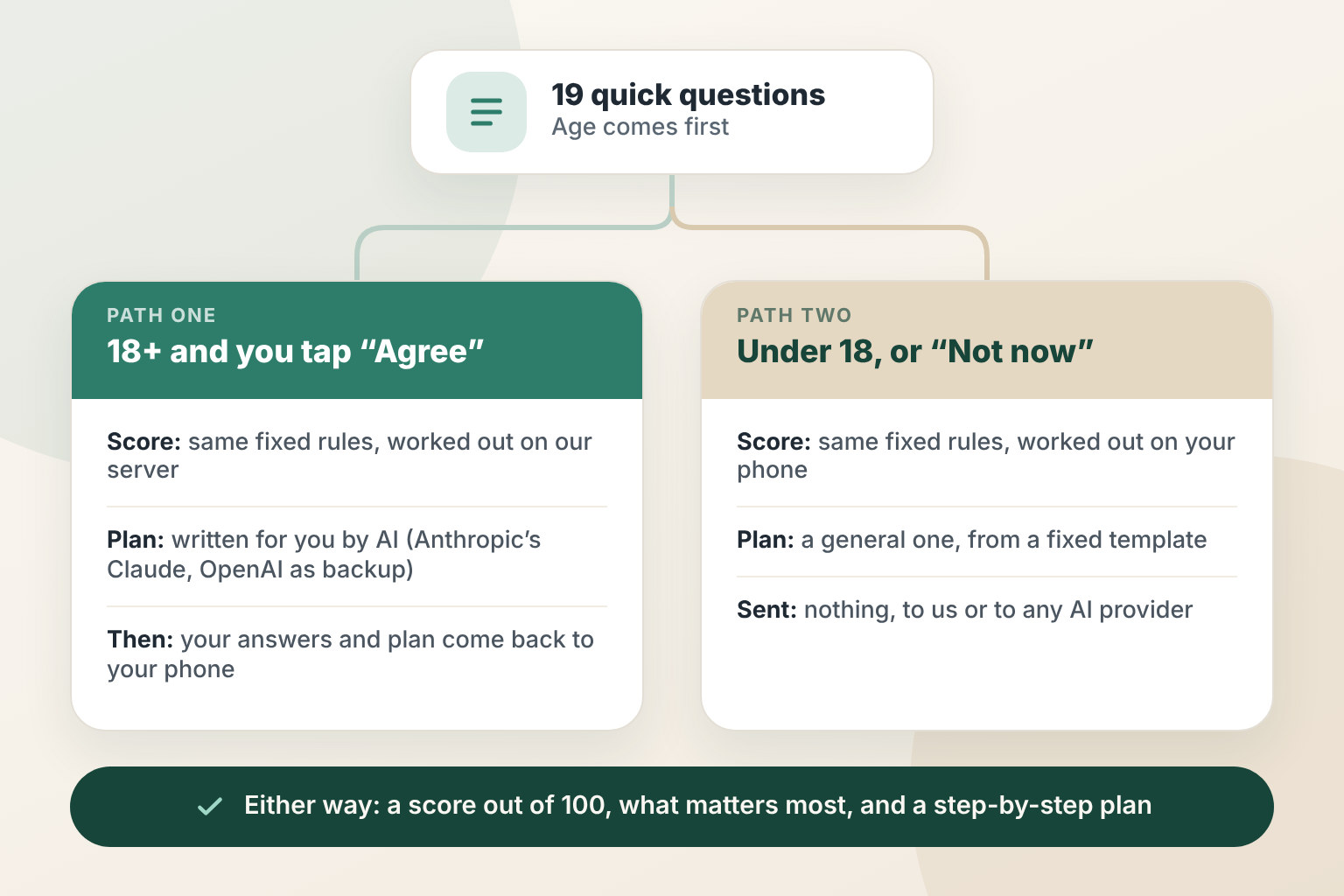
Some of these questions are personal, so the app asks before anything is sent. If you're 18 or over, a short sheet explains exactly what happens before you choose:
- If you tap "Agree and continue": your answers, plus your saved skin type, concerns and pregnancy setting, go to our server. It works out your score and sends the details to Anthropic (Claude) to write your plan, or to OpenAI if Anthropic is unavailable. Neither uses them to train AI models, and both may keep what they receive for up to 30 days for abuse monitoring.
- If you tap "Not now (score on this phone only)": nothing is sent. The same rules work out your score on the phone, and you get a general plan from a fixed template, labelled as not written by AI.
Either way, your answers and plan are kept on your phone, under your account, and left out of iCloud and Android backups. In Settings, under Routine data, you can withdraw permission or delete your routine data at any time. If an AI-written plan ever reads wrong, tap "Report this plan".
Why sun, sleep and smoking carry so much weight
The routine check isn't a skin exam, and the score isn't a measure of how your skin looks. It's a measure of habits. The heaviest ones line up with mainstream advice. The American Academy of Dermatology's tips to reduce premature skin aging start with protecting your skin from the sun, and include not smoking, skipping tanning beds and cleansing gently. For sunscreen, the AAD recommends a broad-spectrum, water-resistant SPF 30 or higher, reapplied about every two hours outdoors and after swimming or sweating. That's why daily SPF and reapplying together are worth 22 of the 30 sun points.
If you have Pro, the same result can become something more visual: two AI portraits of how your skin might look in 10 years, with your current routine and with an improved one. We explain how in Future Face, explained.
Frequently asked questions
How long does the routine check take?
About two minutes. There are 19 multiple-choice questions, one per screen, and the reapplying question is skipped if you never wear sunscreen.
Is my routine score worked out by AI?
No. The score always comes from fixed rules, so the same answers give the same score. AI only writes the plan, and only for adults who agree to it.
Can I take the routine check if I'm under 18?
Yes. Your score and a general plan are worked out on your phone, and your answers aren't sent to us or to any AI provider. Future-face portraits are for adults only.
How many routine checks can I do?
Free accounts get up to 5 a month and Pro includes up to 50, with a limit of 5 in any hour. Monthly allowances reset on the 1st (UTC).
Does my routine score change the Match Score on my scans?
No. The Match Score rates a product's ingredient list against your Skin Profile. The routine score rates your habits. They're separate checks that sit side by side in the app.
Please note. DermDecode provides general cosmetic-ingredient information for educational purposes. It is not medical or dermatological advice and may contain errors. Patch-test new products. If you are pregnant or nursing, consult your OB/GYN or dermatologist before changing your routine.