Feature
Future Face: How DermDecode's AI Skin Aging Simulation Works
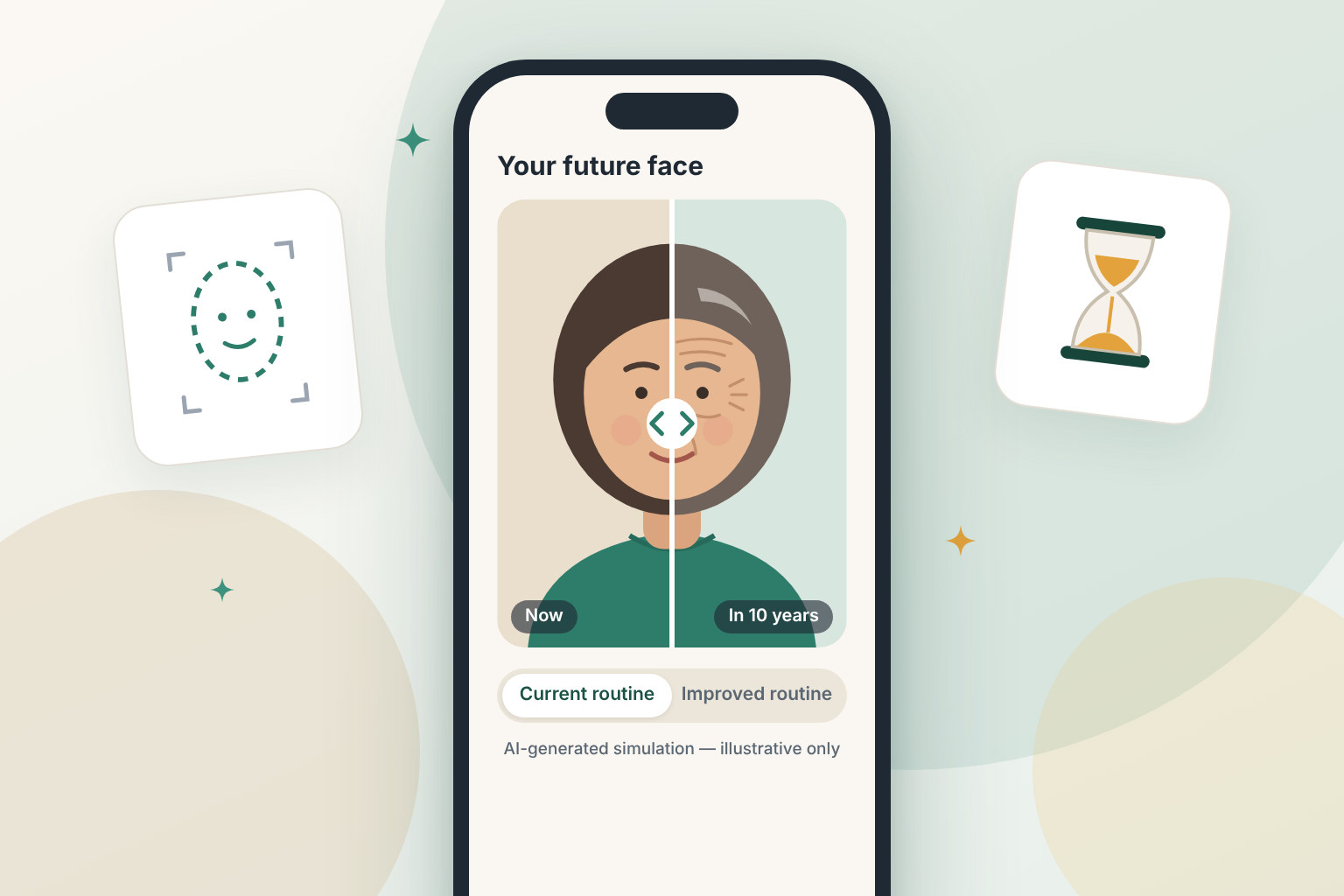
Future Face is DermDecode's AI skin aging simulation. It turns one selfie into two portraits of how your skin might look in 10 years: one if you keep your current routine, and one with an improved routine. A slider lets you drag between today and the future, and a toggle switches between the two scenarios. The portraits are illustrative, not a prediction of how you will age. They're there to make the plan from your routine check feel concrete. Future Face is part of DermDecode Pro and is for adults (18+).
What Future Face shows you
After a routine check, your results include a section called "Your future face". Tap "Create my portraits" and take a selfie. When the set is ready, you get two portraits to compare with your photo:
- Current routine: you in 10 years, with natural aging plus the visible effects of the habits your routine check flagged.
- Improved routine: you in 10 years, aging naturally, with healthy, well-hydrated skin, an even tone and a well-rested look.
Drag the divider to compare your selfie ("Now") with either portrait ("In 10 years"). If dragging isn't easy for you, the Now and In 10 years buttons jump to either side, and with a screen reader the comparison works as an adjustable slider. Every portrait carries the caption "AI-generated simulation — illustrative only", and a "Report this portrait" button sits underneath.
How it works, step by step
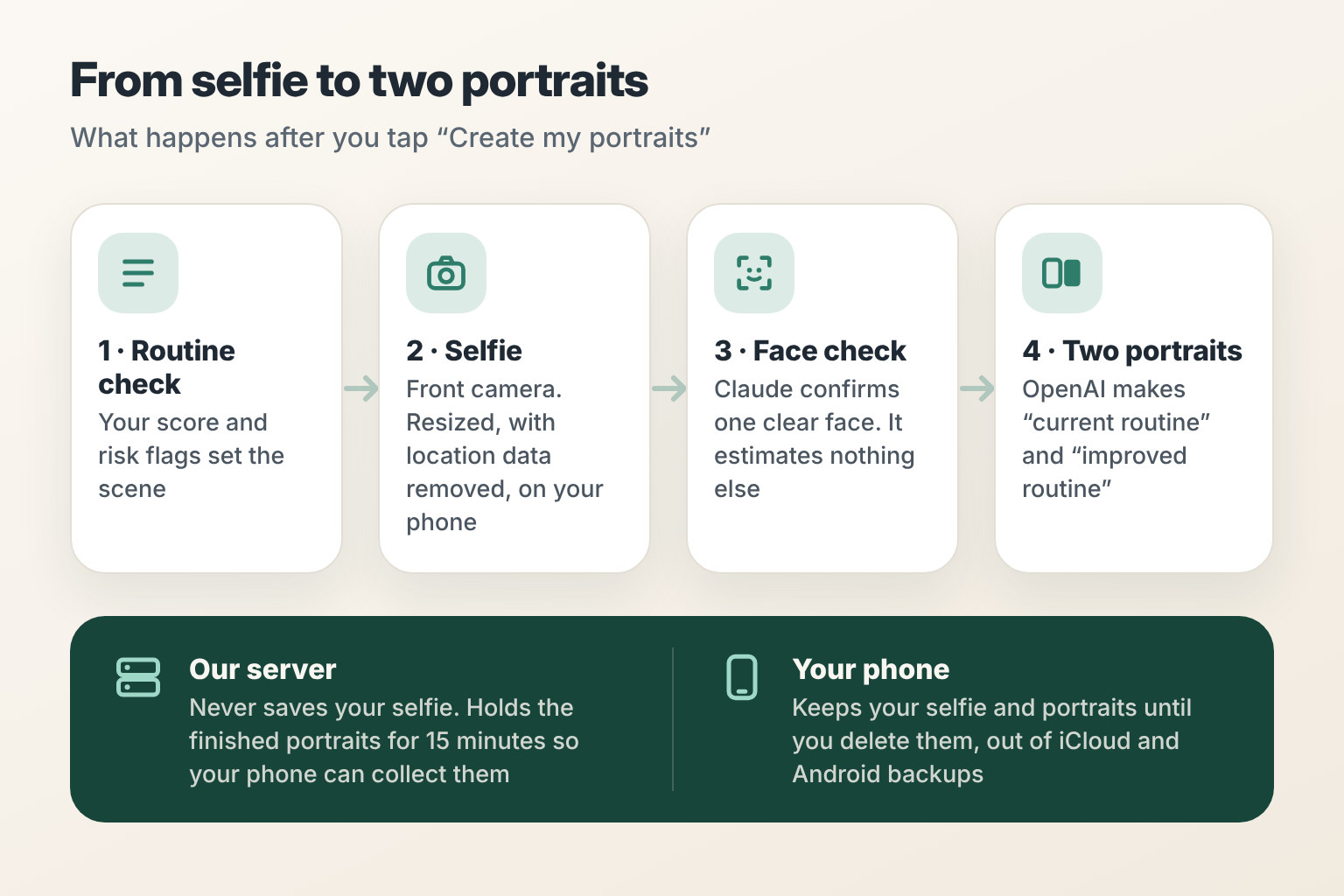
- Do a routine check, and agree to it being sent. Portraits build on a check scored on our server, so they need the "Agree and continue" path. If you'd like to see how the score works first, read how the routine check scores your routine.
- Take a selfie. The app opens the front camera; you can't pick a photo from your library. Face the camera in good light with your whole face inside the oval, no sunglasses or hats, and confirm "This photo is of me". Before upload, the phone resizes the photo and strips its metadata, such as location.
- Face check. Anthropic's Claude checks that the photo shows one clear face, and nothing more. It doesn't estimate your age, skin tone or ethnicity, and no face template is made. If the photo doesn't pass, you'll see "Let's try that photo again" with tips.
- Two portraits. OpenAI creates both portraits from your selfie and a fixed written instruction that describes the visual changes for your result. It never receives your quiz answers.
- Collect them. Keep the app open, or come back within 15 minutes, and your phone collects the set.
What makes the two portraits differ
No AI decides what your routine "deserves". The instruction for the "Current routine" portrait is assembled by fixed rules from the risk flags in your routine check. Each flag adds one description:
| If your routine check flags… | …the current-routine portrait shows |
|---|---|
| No sunscreen, or beach-only, with 1+ hours of sun a day | Deeper forehead lines and crow's feet, scattered sun spots, uneven pigmentation |
| No sunscreen, or beach-only, with less sun | Visible fine lines around the eyes, mild uneven pigmentation |
| Tanning beds | Deep wrinkles, prominent age spots, coarse texture |
| Smoking or vaping | A dull, slightly sallow complexion and fine lines around the lips |
| Under 7 hours' sleep | Dark circles and under-eye bags |
| Under 2 glasses of water a day | Dry, rough-looking skin |
| Sugary food often or at most meals | Less elasticity, mild sagging along the jawline |
| Alcohol daily | Puffiness and visible redness around the nose and cheeks |
| Washing 3+ times a day | Irritated-looking, flaky patches |
| No moisturizer, or only sometimes | Dry, tight-looking skin with more visible fine lines |
| High or very high stress | Deeper frown lines between the eyebrows |
Every portrait starts from 10 years of natural aging for your apparent age.
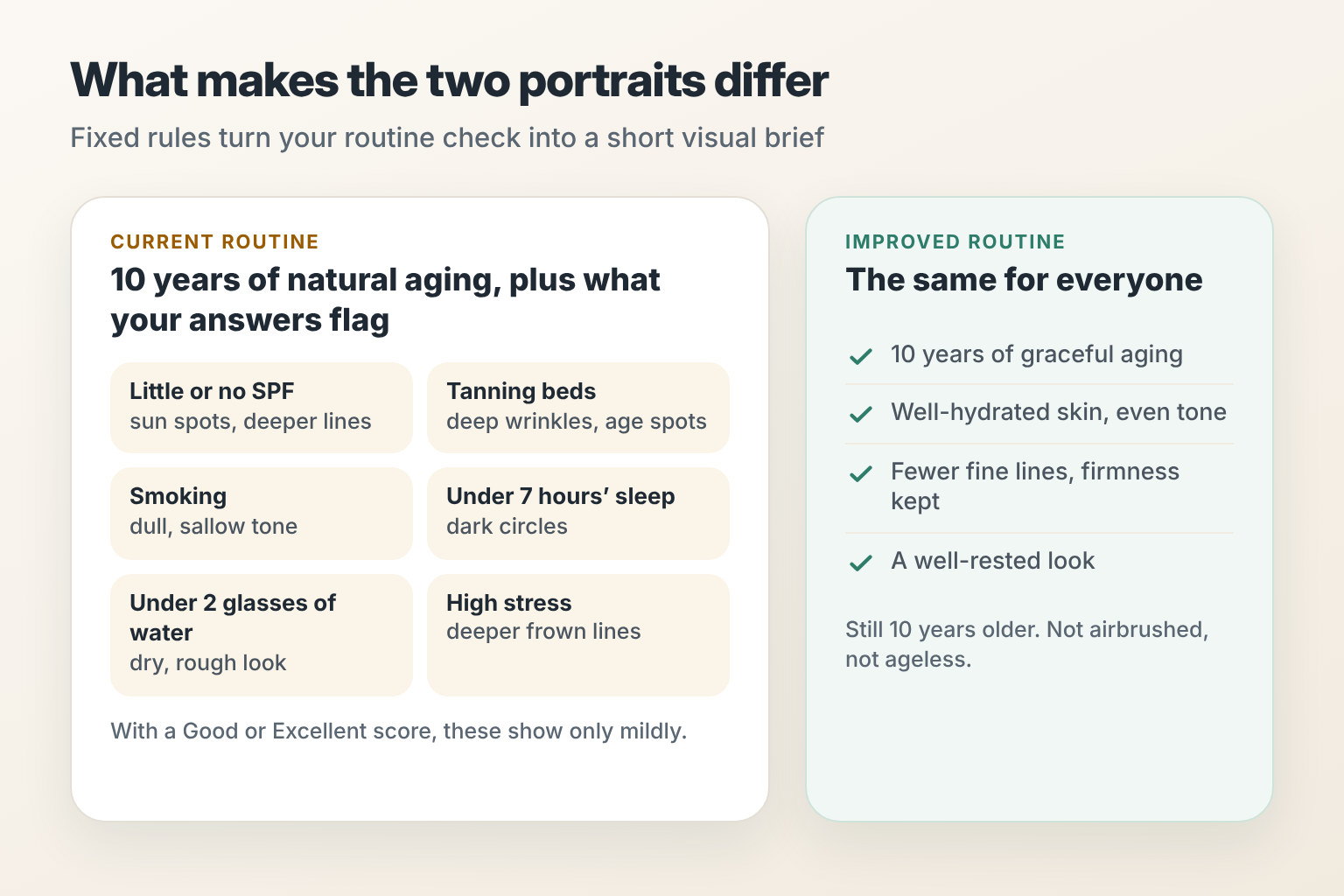
Two rules keep things fair. If your routine score lands in the Good or Excellent band, the flagged changes are rendered "only mildly", so a strong routine isn't drawn as if it were a poor one. And the "Improved routine" portrait isn't airbrushed or ageless: it's still you, 10 years on, with natural, graceful aging.
What an AI skin aging simulation can and can't tell you
Think of the two portraits as a visual version of your plan, not a forecast. They can't account for your genes, your health, your environment or the many things a 19-question check never asks. The same selfie can come out a little differently each time, because image models aren't exact. That's why DermDecode calls them illustrative AI simulations, not predictions of how you will age, and not medical advice.
What they do well is show the direction of travel. The biggest drivers in the brief, sun exposure, tanning and smoking, are the same ones the American Academy of Dermatology lists among its ways to reduce premature skin aging. If the gap between your two portraits is mostly sun damage, the most useful step is usually in your plan already: a broad-spectrum SPF 30 or higher, every day.
If Pregnancy Mode is on, your plan leaves out retinoids and strong acids and points you to your clinician instead. Our Pregnancy Mode guide covers what that switch changes.
Your selfie and portraits: where they go
- You're asked first. The consent sheet for the routine check names who receives your selfie before anything is sent.
- Your selfie is never stored on our server. It's used in memory while the portraits are made, never written to our database or logs. We keep only a one-way hash of the file with the usage record. The hash isn't the photo and can't be turned back into one; it lets us check that a retry uses the same photo.
- Portraits wait 15 minutes, no longer. Finished portraits are held on our server for 15 minutes so your phone can collect them, then deleted, normally within about 16 minutes.
- Everything else is kept on your phone. Your selfie, plan and portraits stay in the app until you delete them, left out of iCloud and Android backups. "Delete this result" removes one check; Settings, under Routine data, removes them all.
- No training. Anthropic and OpenAI may keep what they receive for up to 30 days for abuse monitoring, then delete it. Neither uses it to train AI models.
Portrait sets, trials and reports
A portrait set is the pair: one "Current routine" and one "Improved routine". Pro includes 10 completed sets per calendar month (UTC). They reset on the 1st, and unused sets don't roll over. A free trial for eligible new subscribers includes 2 sets in total. If only one of the two portraits can be made, you'll see "One portrait is missing" with a "Try again" button, and the set only counts once both are ready.
If a portrait looks wrong, offensive or like someone else, tap "Report this portrait", pick a reason and, if you choose, attach the portrait. Attached portraits are kept for up to 90 days so we can review the report.
Frequently asked questions
Is Future Face a prediction of how I'll age?
No. The portraits are illustrative AI simulations built from your routine check. They can't account for genetics, health or anything the check doesn't ask, and they aren't medical advice.
Is my selfie stored?
Not on our server. It's used in memory while the portraits are made, and only a one-way hash is kept. The selfie and portraits are kept on your phone until you delete them, and they're left out of iCloud and Android backups.
Can I use a photo from my camera roll?
No. Future Face only takes a new selfie with the front camera, and you confirm that the photo is of you.
Who can use Future Face?
Adults (18+) with DermDecode Pro, after a routine check they agreed to send. Pro includes 10 portrait sets per calendar month (UTC), and a free trial includes 2.
Please note. DermDecode provides general cosmetic-ingredient information for educational purposes. It is not medical or dermatological advice and may contain errors. Patch-test new products. If you are pregnant or nursing, consult your OB/GYN or dermatologist before changing your routine.