Guide
How to Read Skincare Ingredient Labels (INCI) in Plain English
Learning how to read skincare ingredient labels takes about five minutes, and it starts on the back of the bottle, not the front. The ingredient list, often headed “Ingredients” or “INCI,” names everything in the product using standardized names. Ingredients above 1% are listed from most to least by weight, so the first five or so lines tell you what the product mostly is. Below 1%, the order is no longer guaranteed. Colorants go at the end, EU labels name fragrance allergens such as linalool individually, and “may contain (+/-)” marks shade pigments that may not be in your bottle at all.
Why the front of the bottle doesn’t count
The front of the pack is where a brand decides what to tell you: “with vitamin C,” “hydrating,” “for sensitive skin.” That’s marketing: the brand chooses what to put in front of you. The ingredient list has to follow fixed rules on names and order: in the EU under Article 19 of the Cosmetics Regulation (EC) No 1223/2009, and in the US by 21 CFR 701.3.
So turn the product over. On small tubes and jars the list is often on the outer box, which is worth keeping until you’ve read it. A star ingredient on the front might sit at #3 or #23 on the back.
Skincare ingredient order: what position tells you, and where it stops
EU and US rules start the same way: ingredients are listed in descending order of amount. That’s why water (Aqua) is so often #1, since many creams, serums and lotions are mostly water. Three exceptions explain most of the confusion:
| Part of the list | EU rule | US rule | What it means for you |
|---|---|---|---|
| Ingredients above 1% | Descending order of weight | Descending order of predominance | The top of the list really is the bulk of the product. |
| Small amounts, around 1% and below | Under 1%: any order, after those above 1% | 1% or less: any order, after those above 1% (an optional grouping) | Past the 1% line, a lower position no longer means a smaller amount. |
| Colorants | Any order, after the other ingredients | Any order, at the end (same optional grouping) | Pigments at the tail tell you nothing about amount. |
| Shade ranges | “May contain” or “+/-” allowed | “May contain” allowed | Listed pigments may not be in your shade. |
Sources: Regulation (EC) No 1223/2009, Article 19(1)(g); 21 CFR 701.3(a), (f) and (g).
The 1% line is invisible
Labels don’t mark where the 1% line falls. One clue works on many products sold in the EU: the preservative Phenoxyethanol is capped at 1% of the finished product under Annex V of the same regulation, so anything listed after it is present at about 1% or less. Not every product uses it, so treat it as a hint, not a rule. And remember that position measures amount, not strength: some ingredients do their job at a fraction of a percent.
Here is an example list for a tinted moisturizer, written for this guide:
- Aqua
- Glycerin
- Caprylic/Capric Triglyceride
- Cetearyl Alcohol
- Niacinamide
- Butyrospermum Parkii Butter
- Dimethicone
- Phenoxyethanol
- Sodium Hyaluronate
- Tocopherol
- Parfum
- Linalool
- Limonene
- [+/- CI 77891, CI 77491, CI 77492]
An illustrative list, not a real product.
#1 to #4 are the base: water, a humectant, a light oil and a waxy thickener. Niacinamide at #5 comes before the 1% clue, so it may be above 1%, but the label can’t confirm that. Phenoxyethanol at #8 is the clue, so everything after it is a small amount in no guaranteed order. Linalool and limonene are declared fragrance allergens, and the bracketed pigments belong to the shade range.
Standard INCI names: aqua, parfum and name families
EU labels use a shared glossary of common ingredient names, usually called INCI names. Plants appear under Latin botanical names, water is Aqua and fragrance is Parfum. US rules ask for “common or usual names,” but FDA doesn’t object to adding the INCI name in parentheses. That’s why products sold in both markets say “Water (Aqua)” or “Fragrance (Parfum).”
| On the label | In plain English |
|---|---|
Aqua, Water | Water |
Parfum, Fragrance | A fragrance blend, declared as one item |
Butyrospermum Parkii Butter | Shea butter |
Tocopherol | Vitamin E |
Sodium Hyaluronate | A salt form of hyaluronic acid |
Niacinamide | A form of vitamin B3 |
CI 77891 | Titanium dioxide as a colorant (CI = Colour Index number) |
A name followed by (nano) | On EU labels, present as a nanomaterial |
Families: many names, one group
If you avoid a group, learn its members: parabens (Methylparaben, Propylparaben, Butylparaben), polysorbates (Polysorbate 20, Polysorbate 80), PEG esters (PEG-100 Stearate) and ceramides (Ceramide NP, Ceramide AP). The reverse trap matters too: Cetearyl Alcohol is a waxy fatty alcohol used as a thickener, not the Alcohol Denat. that people who avoid drying alcohols look for.
Fragrance allergens near the end of the list
Under EU rules, a fragrance blend is declared as Parfum, and certain fragrance allergens inside it must also be named once they pass 0.001% in leave-on products or 0.01% in rinse-off products. Those are tiny amounts, which is why Linalool, Limonene, Citronellol or Geraniol usually turn up in the tail, often right after Parfum.
That tail is getting longer. Commission Regulation (EU) 2023/1545 added 56 fragrance allergens to the 24 that already needed their own line. Products placed on the EU market from 31 July 2026 must comply, and products placed on the market before then can stay on sale until 31 July 2028, so you’ll see old and new labels side by side for a while.
US rules let a manufacturer declare the whole blend simply as “fragrance,” so individual allergens may go unnamed. The Modernization of Cosmetics Regulation Act requires FDA to write fragrance-allergen labeling rules, so that may change.
Worth knowing
A named allergen is a disclosure, not a verdict. It’s there so people already sensitized to a specific substance can avoid it. If a product leaves your skin itchy, red or irritated, see a dermatologist, who can patch-test to find out which substance, if any, you’re reacting to.
“May contain (+/-)”: colorants for a whole shade range
Makeup and tinted products come in several shades, so EU and US rules let a brand list every colorant used across the range once, marked “may contain” (or “+/-” on EU labels). Your shade probably contains only some of them. The pigments usually appear as CI numbers, such as CI 77891 (titanium dioxide) or CI 77491 (an iron oxide), in any order. If you react to a specific pigment, only the brand can confirm whether your shade has it.
How to read skincare ingredient labels: a five-step checklist
- Find the real list. Flip the product or check the box for the block headed “Ingredients” or “INCI.”
- Read the top five lines. They are what the product mostly is. A front-label star far down the list is there in a small amount.
- Look for the 1% clue. Find phenoxyethanol or another low-level ingredient, and treat everything after it as small amounts in no set order.
- Translate and group the names. Check for the families you care about and, if you avoid fragrance, for named allergens as well as
Parfum. - Set aside the “may contain” pigments, then ask what matters for your skin. The same list can suit one person and clash with another. See how to check whether a product is right for your skin, and comedogenic ratings explained for why a pore-clogging rating is a heads-up, not a verdict.
Then patch-test before using a new product all over your face.
Photographing a tiny, curved label, and how DermDecode reads it
These tips come from the scan-error messages we wrote for DermDecode. They work just as well if you’re only zooming in with your phone’s camera:
- Photograph the back and fill the frame with the ingredients list.
- On a curved bottle, try the box, or rotate slowly and capture the flattest stretch of the label.
- For glare, tilt the product slightly away from the light, or switch your phone’s light off.
- If it’s blurry, hold steady, get closer and let the camera focus. A light helps in a dim room.
- Keep the whole list in frame. Order matters, and a cut-off list is a different list.
- If the packaging isn’t in Latin script, look for an imported-goods sticker with the INCI list.
How DermDecode weights ingredient position
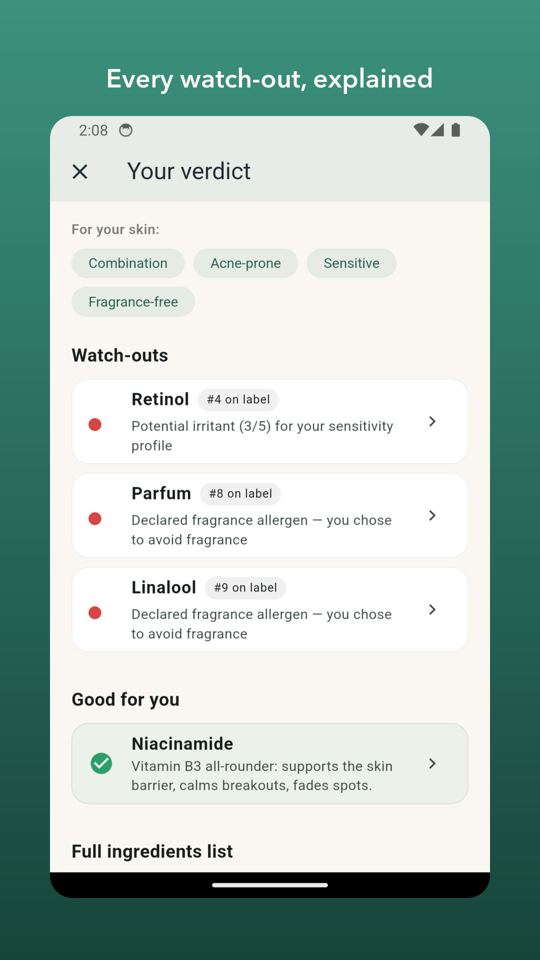
DermDecode splits the job in two. An AI model transcribes the INCI list from your photo in printed order, keeping may-contain pigments separate. It doesn’t judge anything. Code does the scoring, checking each ingredient against a human-reviewed knowledge base of 121 entries (family entries such as parabens cover several INCI names) and against the skin profile you set up. Position feeds straight into the score:
| Position on the label | Weight in the score |
|---|---|
| #1 to #5 | ×1.5 |
| #6 to #10 | ×1.0 |
| #11 and later | ×0.5 |
| May contain (+/-) | ×0.25 |
A fixed design choice, not a measurement: the app can’t see the 1% line any more than you can.
Each watch-out carries a badge like #4 on label, so you can find it on the pack. The full list appears in printed order, may-contain pigments collapse into their own row, and ingredients the knowledge base doesn’t cover yet stay as plain grey chips (press and hold one and it says “No data yet”) rather than getting a guess. The same ingredient list with the same skin profile gives the same verdict.
DermDecode isn’t in the app stores yet. Until it is, the home page walks through how a scan works.
Frequently asked questions
Are skincare ingredients listed in order of amount?
Yes, down to the 1% line. Ingredients above 1% are listed in descending order. Below that (under 1% in the EU, 1% or less in the US) they can follow in any order, and colorants can go at the end in any order.
What does “may contain” or +/- mean on a cosmetics label?
It marks colorants used across a range of shades. The brand lists every pigment in the range once, so your shade may contain only some of them.
What does aqua mean on a skincare label?
Water. Aqua is the INCI name used on EU labels, and US labels may show “Water (Aqua).” It’s often #1 because many products are mostly water.
Why are linalool and limonene on my moisturizer’s label?
EU rules treat them as fragrance allergens, so they must be named once they pass 0.001% in a leave-on product. They often come from a fragrance blend or essential oils. Their presence is a disclosure for people sensitized to them, not a sign the product will bother everyone.
Please note. DermDecode provides general cosmetic-ingredient information for educational purposes. It is not medical or dermatological advice and may contain errors. Patch-test new products. If you are pregnant or nursing, consult your OB/GYN or dermatologist before changing your routine.