Walkthrough
How to Know If a Skincare Product Is Right for Your Skin Type
There's no universal good or bad skincare product, only good and bad matches. So the practical answer to how to know if a skincare product is right for your skin is to check the back label against three things about you: your skin type, your concerns, and anything you've chosen to avoid. Dry or sensitive skin should look hardest at irritancy. Oily or breakout-prone skin should look hardest at pore-clogging potential. Your avoid-list, pregnancy included, covers the rest. Then patch-test, because a label can only tell you so much.
Why the same label can suit one person and clash with another
Take a rich cream built on plant oils and butters. For skin that feels tight by lunchtime, that richness is the point. For oily, breakout-prone skin, those same heavy oils are worth a second look.
Or take a serum with retinol and a little fragrance. Someone with sturdy skin and no preferences has little to weigh. Someone with sensitive skin who avoids fragrance has three things to think about. The bottle didn't change. The person did.
Two properties do most of the sorting:
- Irritancy: how likely an ingredient is to sting, redden or dry out skin. It matters most for easily upset skin.
- Pore-clogging potential: how likely an ingredient is to contribute to clogged pores. It matters most for oily and breakout-prone skin, and the ratings behind it are rougher than they look. We cover why in comedogenic ratings explained.
How to know if a skincare product is right for your skin: a checklist by skin type
Find your row, then read the label with that lens. If you fit more than one row (plenty of people are oily and sensitive), check both.
| Your skin or concern | Look hardest at | Examples to spot on the label |
|---|---|---|
| Dry | Irritancy and drying ingredients | Alcohol Denat. high on the list, strong fragrance, retinoids and exfoliating acids |
| Oily or combination | Pore-clogging potential | Heavy oils and esters near the top, such as Isopropyl Myristate or Cocos Nucifera Oil |
| Breakouts or acne | Pore-clogging potential | The same oils and esters, especially in the first five lines |
| Sensitivity, redness, rosacea or eczema-prone | Irritancy | Parfum and named fragrance allergens, essential oils, drying alcohols, retinoids and acids |
| Fungal acne ("tiny itchy bumps") | Commonly cited trigger families | Some fatty acids, esters, plant oils and polysorbates (get a diagnosis first) |
| Normal | Your own preferences | Whatever is on your avoid-list |
A heads-up, not a rulebook.
Before you buy, turn it over and check
- The first five or so ingredients. US rules list ingredients in descending order of amount, but anything at 1% or less may follow in any order (21 CFR 701.3). The top of the list tells you the most.
- Where each watch-out sits. A flagged ingredient at #3 is a different story from the same one at #25.
- Fragrance near the end:
Parfum,Fragrance, or named allergens likeLinaloolandLimonene. - Anything on your avoid-list, under all its names.
- Retinoids if you're pregnant, nursing or trying to conceive.
If the names themselves are the obstacle, start with how to read skincare ingredient labels.
Front-of-pack words won't do this job for you. The FDA says there are no federal standards or definitions for "hypoallergenic", and companies don't have to prove the claim to the agency.
Your own avoid-list: fragrance, essential oils, drying alcohols and more
Skin type is half the picture. The other half is personal: things you'd rather not put on your face, for reasons that are yours. The common ones:
- Fragrance. On US labels, a whole fragrance blend can appear as a single word. The FDA also notes that some "unscented" products contain fragrance ingredients, added just to mask the smell of other ingredients. "Unscented" and "fragrance-free" aren't the same promise.
- Essential oils, such as lavender, tea tree, peppermint or citrus peel oils. People avoiding fragrance often avoid these too.
- Drying alcohols, such as
Alcohol Denat.andIsopropyl Alcohol. Fatty alcohols likeCetearyl Alcoholare a different thing: waxy moisturizers that are alcohols in name only. - Sulfates, silicones and parabens. These are usually preferences rather than skin-type issues, and that's fine.
None of these is a problem for everyone. An avoid-list is a filter, not a verdict on the ingredient, and it's fine for yours to be short.
Pregnancy and nursing: flag it, then talk to your OB/GYN
If you're pregnant, nursing or trying, the label gets one extra pass: retinoids, which show up under several names, from prescription tretinoin to retinol in over-the-counter serums. ACOG notes that little of a topical retinoid is absorbed, but that avoiding them during pregnancy is generally recommended, and it suggests talking with your dermatologist and ob-gyn about options.
Beyond retinoids, advice varies. Treat any flag as a question for your OB/GYN or midwife, not an answer.
Three steps in DermDecode: profile, scan, read the match
Everything above works with a label and some patience. DermDecode, our app for iPhone and Android, runs the same check in one scan, against your profile rather than average skin.
- Set your Skin Profile. Four quick questions: your skin type (Oily, Dry, Combination, Normal or Not sure), your main concerns (pick as many as apply, from breakouts and sensitivity to rosacea, eczema and fungal acne), anything to strictly avoid, and an optional Pregnancy Mode. You can edit it later in Settings.
- Scan the back label. Point the camera at the ingredient list. An AI model reads and transcribes the label and nothing more. The photo goes to our server and on to OpenAI for that one reading, and DermDecode doesn't store it.
- Read the match. A Match Score from 0 to 100 lands in one of four tiers: Great match (85–100), Decent match, minor watch-outs (65–84), Use with caution (40–64) or Likely to clash with your skin (0–39). Below it: Watch-outs sorted by impact, each with a plain reason and its label position, then Good for you and the full list.
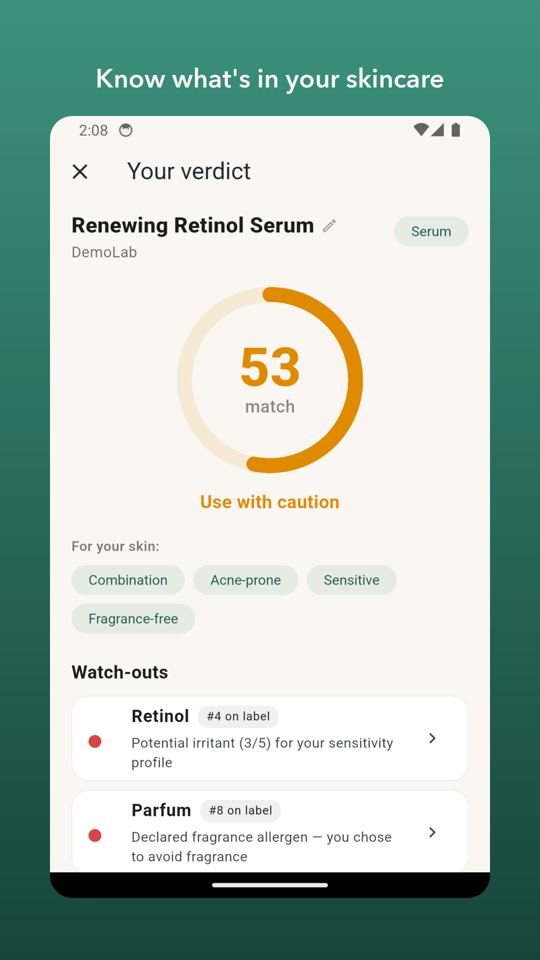
Here's where that 53 comes from. Retinol sits at #4, and the first five ingredients count one and a half times, so its irritancy flag for a sensitive profile weighs the most. Parfum (#8) and Linalool (#9) are flagged because this profile avoids fragrance. Niacinamide earns a small bonus under Good for you. Switch on Pregnancy Mode and the same serum drops into the red tier, with a banner saying retinol is commonly advised against during pregnancy and to talk to your OB/GYN.
The AI reads the label, and fixed rules do the scoring against a human-reviewed knowledge base of 121 ingredient entries. The same ingredient list and the same profile always give the same verdict. Ingredients not covered yet say "No data yet" instead of guessing. It's free to try with 3 scans and no sign-up, and an optional Pro subscription, monthly or annual, removes the scan limit and ads.
Then patch-test
No label check, ours included, can tell you how your skin will actually react. The American Academy of Dermatology's at-home method is simple:
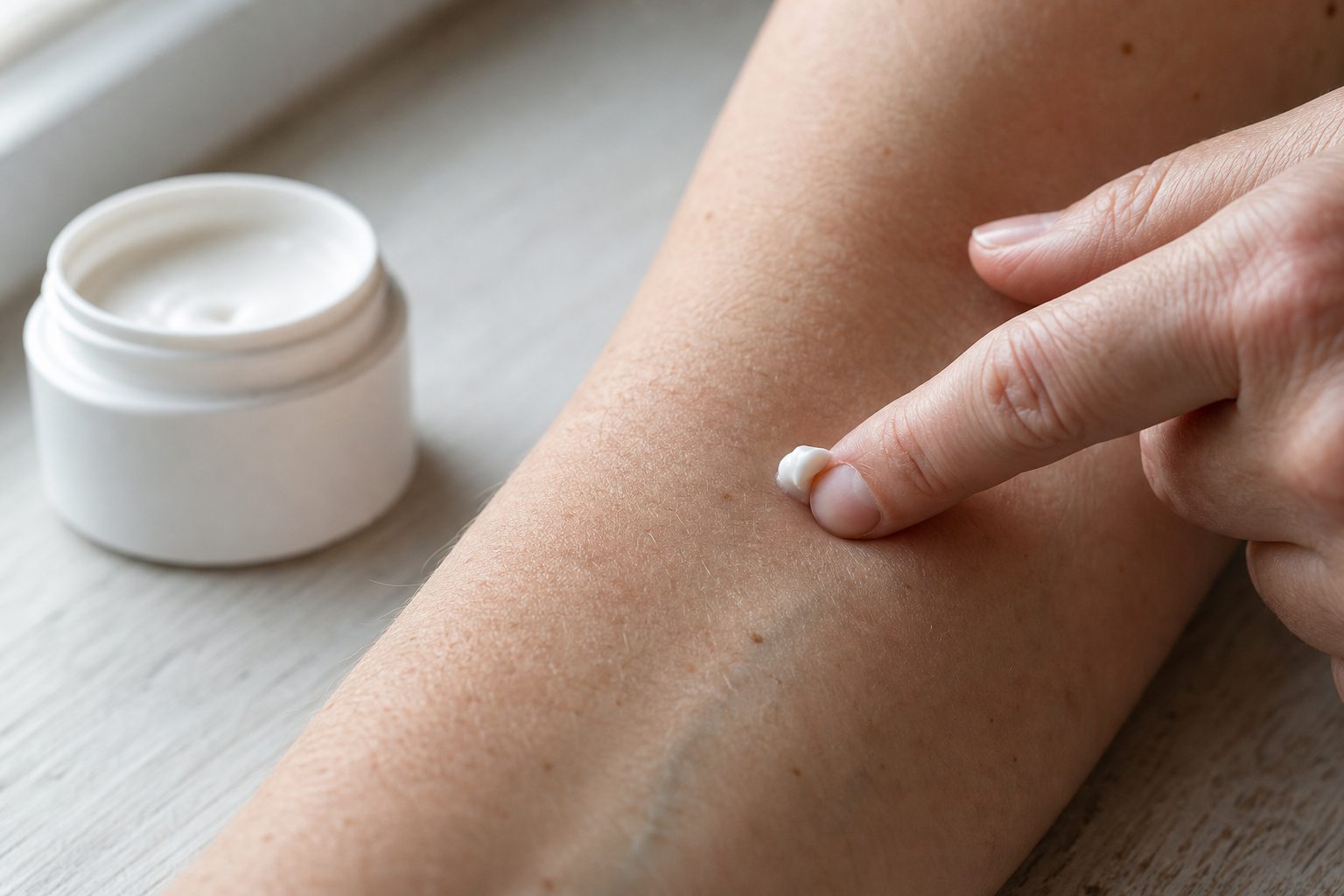
- Pick a spot. Choose a quarter-sized patch where the product won't be rubbed or washed off, such as the underside of your arm or the bend of your elbow.
- Use it as normal. Apply your usual amount twice a day for 7 to 10 days, and leave it on as long as you normally would.
- Watch, then decide. If you get red, itchy or swollen skin, gently wash it off and stop using it. No reaction after 7 to 10 days means you can go ahead.
When to see a dermatologist
The AAD notes that ingredients like retinol can cause temporary irritation, especially on sensitive skin. If you can't tell irritation from a reaction, if a reaction is severe, or if symptoms persist or get worse, see a dermatologist, who can run formal patch testing.
Frequently asked questions
How long should you patch-test a new skincare product?
The American Academy of Dermatology suggests applying it to a small test spot twice a day for 7 to 10 days. If there's no redness, itching or swelling by then, you can use it as normal.
Does "hypoallergenic" mean a product will suit sensitive skin?
Not necessarily. In the US there's no federal standard or definition for the term, and companies don't have to prove it to the FDA. The ingredient list and a patch test tell you more.
Is "unscented" the same as "fragrance-free"?
No. The FDA notes that some unscented products contain a little fragrance to mask other smells. Check the list for Parfum, Fragrance and named allergens.
Can a skincare ingredient checker tell me if a product will work for me?
It can show how the ingredient list lines up with your skin type, concerns and preferences. It can't predict your individual reaction or say whether a product is medically right for you. Patch-test, and see a dermatologist for anything persistent.
What if I don't know my skin type?
In DermDecode you can choose "Not sure". The app then uses Combination as a middle-ground default, and you can change it in Settings whenever you like. A dermatologist can also help you work it out.
Please note. DermDecode provides general cosmetic-ingredient information for educational purposes. It is not medical or dermatological advice and may contain errors. Patch-test new products. If you are pregnant or nursing, consult your OB/GYN or dermatologist before changing your routine.