Feature
Pregnancy Mode: Spotting Skincare Ingredients to Avoid During Pregnancy
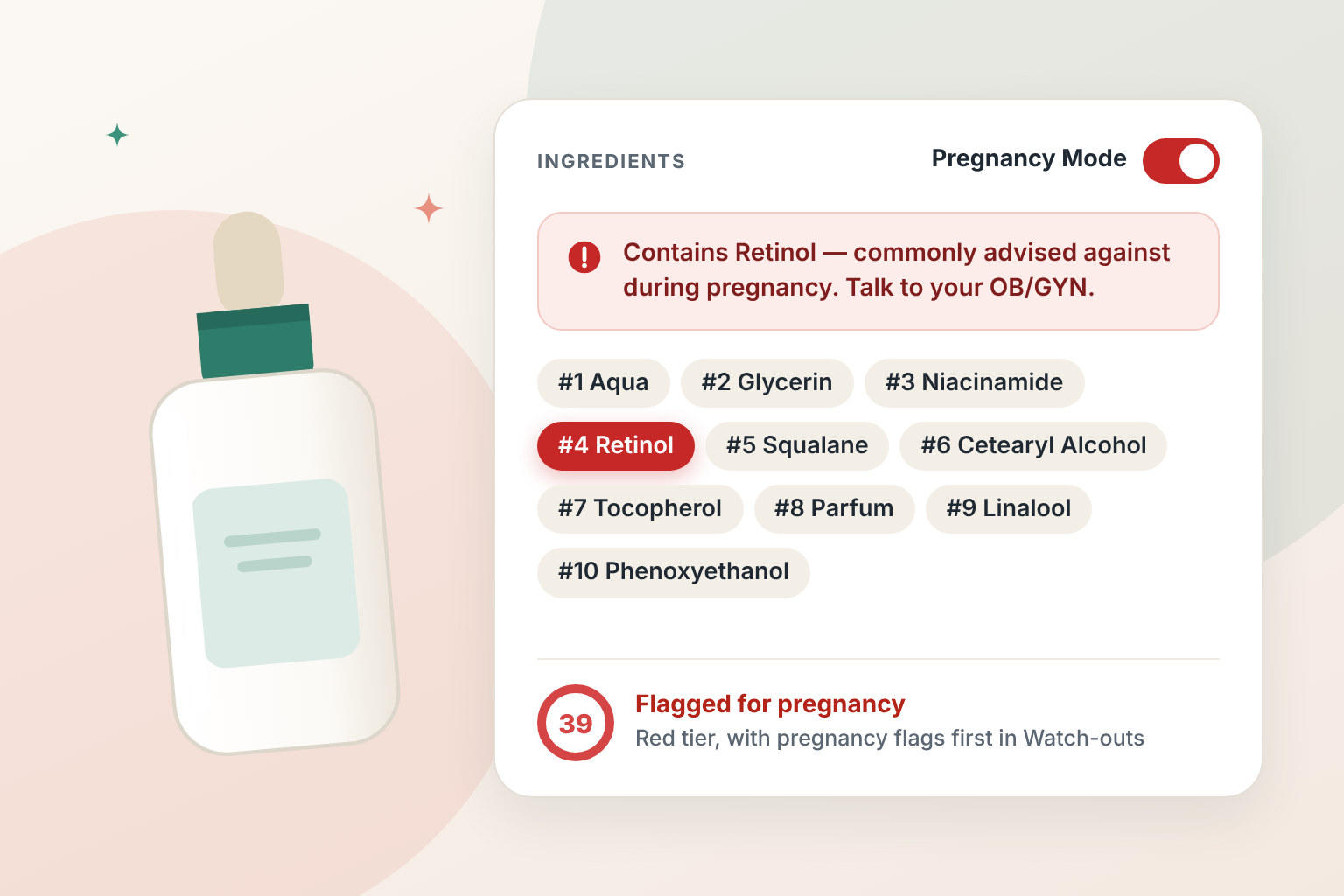
When you're pregnant or nursing, the list of skincare ingredients to avoid during pregnancy usually starts with retinoids and hydroquinone. Beyond those, advice varies and labels don't make it easy. DermDecode's Pregnancy Mode is one switch in your Skin Profile. Once it's on, every scan checks the ingredient list against 14 pregnancy entries, under every label name they go by. Six are hard-flagged as commonly advised against and put the product in the red tier with a banner. Eight get a caution that lowers the score and tells you to ask your OB/GYN. It's free, and it's information to take to your clinician, not a substitute for one.
How to turn on Pregnancy Mode
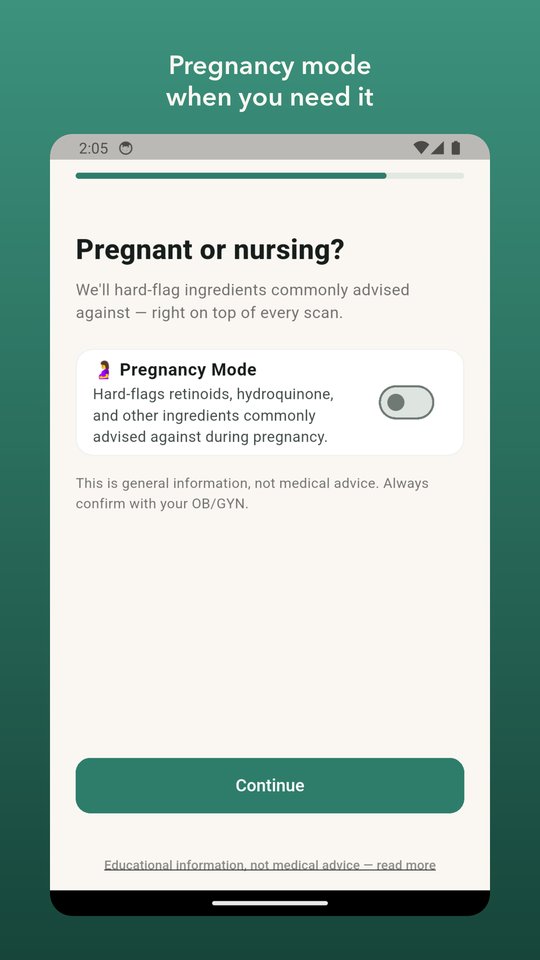
During setup, one screen asks "Pregnant or nursing?" with a Pregnancy Mode switch. If you skipped it, or your situation changes, open Settings, tap Skin profile and flip the switch there. Your Skin profile row then shows "Pregnancy Mode" next to your skin type, so you can see at a glance that it's on. Turn it off again whenever you like.
Skincare ingredients to avoid during pregnancy: the hard flags
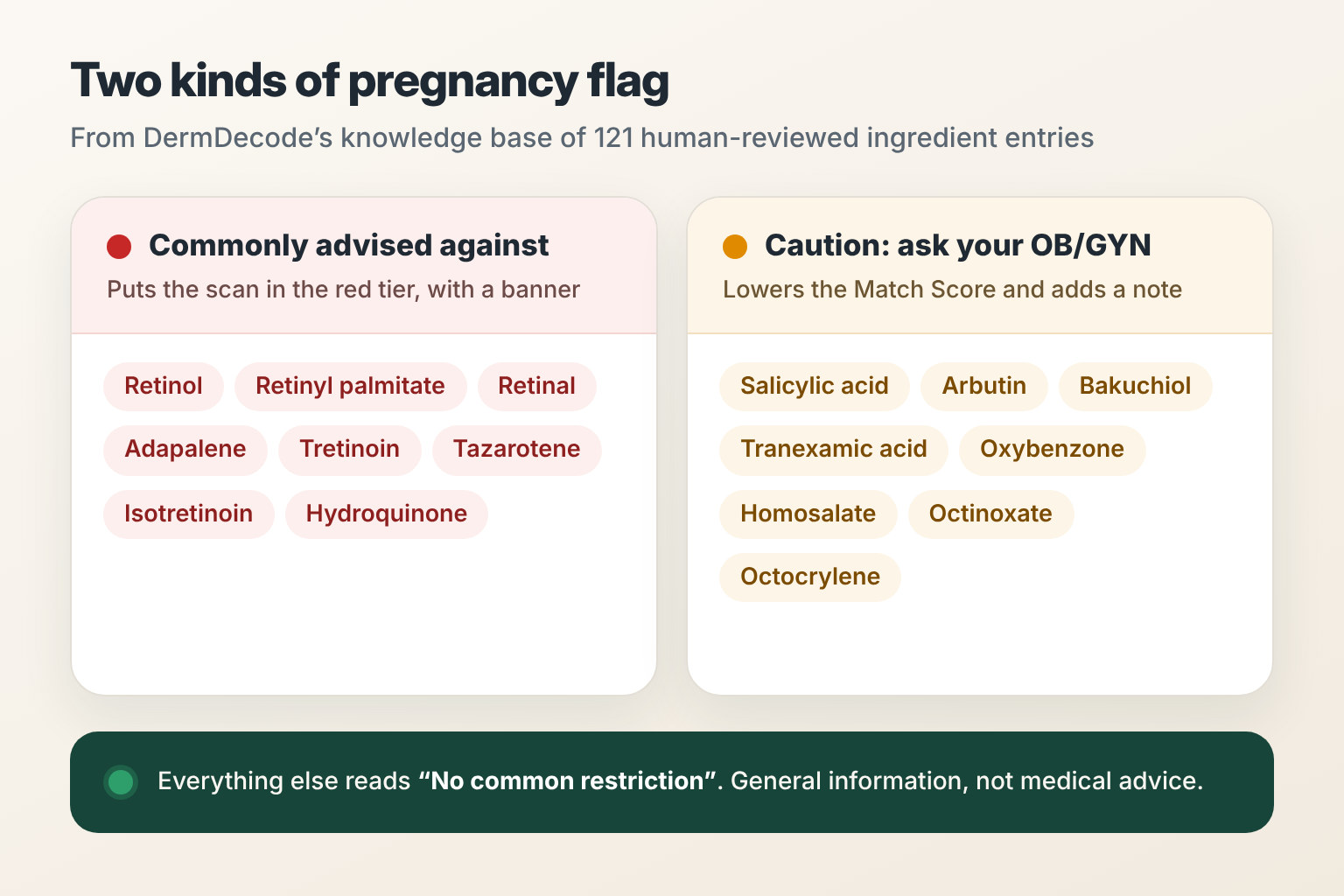
Six entries in the knowledge base are marked "commonly advised against". Each one matches several label names:
- Retinol and its relatives:
Retinol,Retinyl Palmitate,Retinyl Acetate,Retinal(also writtenRetinaldehyde) andHydroxypinacolone Retinoate. - Adapalene, a retinoid sold over the counter for acne.
- Tretinoin (also called retinoic acid) and tazarotene, prescription retinoids.
- Isotretinoin, a retinoid used for severe acne.
- Hydroquinone, a strong skin-lightening ingredient that's absorbed through the skin more than most.
Retinoids lead the list for a reason. The American College of Obstetricians and Gynecologists (ACOG) notes that little of a topical retinoid is absorbed, but avoiding them during pregnancy is generally recommended, and suggests talking with your dermatologist and ob-gyn about other options.
What a hard flag does to your scan
With Pregnancy Mode on, the analyzing screen adds a line, "Checking pregnancy flags…". If the list contains any hard-flagged ingredient:
- A red banner goes to the top of your verdict: "Contains Retinol — commonly advised against during pregnancy. Talk to your OB/GYN."
- The score drops into the red tier. The Match Score is capped at 39, the bottom band, and the ring reads "Flagged for pregnancy". Where the ingredient sits on the label doesn't matter. At #4 or #24, it's flagged the same.
- It leads the Watch-outs, marked "Commonly advised against during pregnancy", and it won't also show up under Good for you, even if it would otherwise count as a benefit for your skin.
Caution flags: a question for your OB/GYN
Eight more entries get a caution, not a hard flag. The evidence is thinner or more mixed, so the app lowers the score and adds "Pregnancy caution — discuss with your OB/GYN before use". How much depends on position: 22.5 points in the first five ingredients, 15 at #6 to #10 and 7.5 after that, because ingredients near the top usually make up more of the formula. Our guide to reading skincare ingredient labels explains why order matters.
| Caution ingredient | Why it's flagged |
|---|---|
| Salicylic acid (BHA) | Low-percentage, rinse-off use is widely considered acceptable, but leave-on and higher strengths are a question for your OB/GYN |
| Arbutin, alpha-arbutin | A gentle brightener that converts to hydroquinone in the skin |
| Bakuchiol | A plant-based retinol alternative with limited pregnancy data |
| Tranexamic acid | A brightener for dark patches with limited topical pregnancy data |
| Oxybenzone, homosalate, octinoxate, octocrylene | Chemical UV filters under review for absorption, and in some cases hormone effects |
Summaries from DermDecode's knowledge base. Your clinician knows your situation; the app doesn't.
Why four sunscreen filters get a caution
Sunscreen still matters during pregnancy. The caution is about specific filters, not about wearing SPF. In 2019 the US FDA proposed that only zinc oxide and titanium dioxide had enough data to be recognized for sunscreen use, and asked manufacturers for more data on 12 other filters, oxybenzone, homosalate, octinoxate and octocrylene among them. In the EU, Regulation (EU) 2022/1176 tightened the limits on oxybenzone (benzophenone-3) and octocrylene after a scientific review. Zinc oxide and titanium dioxide, the two mineral filters, carry no pregnancy flag in DermDecode.
Beyond scans: ingredient pages and the routine check
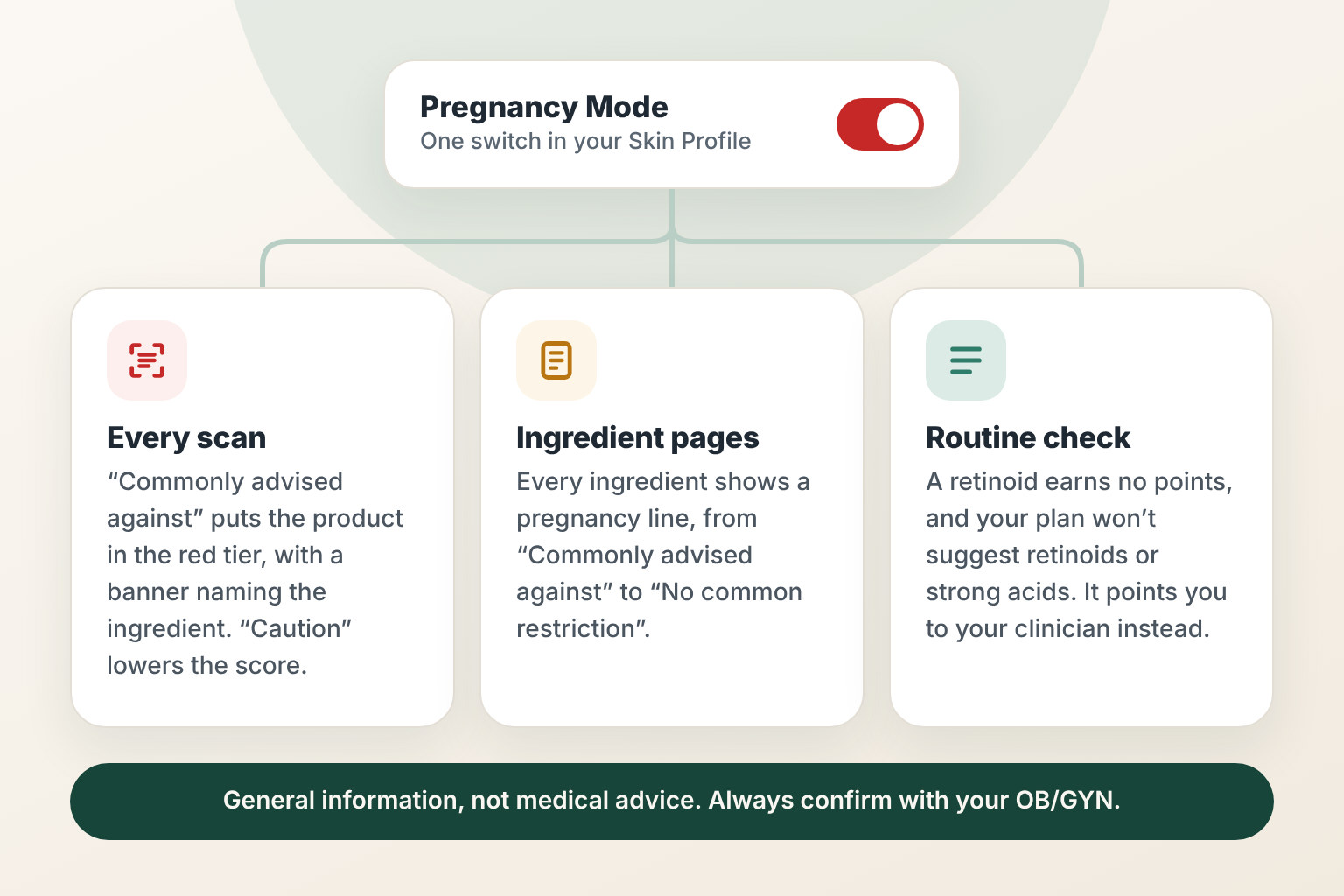
Tap any ingredient on a verdict and its page has a Pregnancy line, whether or not the switch is on: "Commonly advised against", "Caution — ask your OB/GYN" or "No common restriction". Some ingredients often discussed for acne or dark spots during pregnancy, such as azelaic acid and benzoyl peroxide, read "No common restriction".
The routine check reads the same setting. With Pregnancy Mode on, using a retinoid earns no points toward your score. If an AI writes your plan, it's told never to recommend retinoids, tretinoin, adapalene or high-strength acids and to suggest a clinician instead. The on-phone plan adds a step called "Check your products with your clinician".
What Pregnancy Mode can't tell you
- No flag doesn't mean cleared. The knowledge base covers 121 entries. Anything outside it shows "No data yet" rather than a guess, and fragrance blends can hide dozens of ingredients behind one word.
- It can't know the strength. Labels rarely give percentages, and a 0.5% wash isn't a 2% leave-on serum. Position on the list is only a rough guide.
- Advice differs for nursing. The same switch covers "pregnant or nursing", but the advice for breastfeeding isn't always the same as for pregnancy. Ask your clinician about your own case.
- It's not medical advice. Treat every flag as a question to bring to your OB/GYN, midwife or dermatologist, especially for prescription products.
DermDecode treats your pregnancy setting as sensitive information. It's never used to target ads or shared with advertisers, and it's sent to an AI provider only if you agree to the routine check, so your plan can leave out ingredients commonly advised against.
Frequently asked questions
Is Pregnancy Mode part of Pro?
No. Pregnancy Mode, your Skin Profile, every watch-out and the routine check are free for everyone. Pro removes the scan limit and ads, and adds more routine checks and future-face portraits.
Does Pregnancy Mode flag salicylic acid?
It gets a caution, not a hard flag. Low-percentage, rinse-off salicylic acid is widely considered acceptable during pregnancy, but check leave-on products and higher strengths with your OB/GYN.
What if a retinoid is near the end of the ingredient list?
It's still a hard flag. Hard flags ignore position, so the product goes in the red tier with a banner wherever the retinoid appears.
Can I switch Pregnancy Mode off after my baby is born?
Yes. Open Settings, tap Skin profile and turn it off. Scans from then on use your profile without pregnancy flags. If you're nursing, ask your clinician before bringing back products you paused.
Please note. DermDecode provides general cosmetic-ingredient information for educational purposes. It is not medical or dermatological advice and may contain errors. Patch-test new products. If you are pregnant or nursing, consult your OB/GYN or dermatologist before changing your routine.